
ACADEMICS
OVERVIEW
PROGRAM STRUCTURE
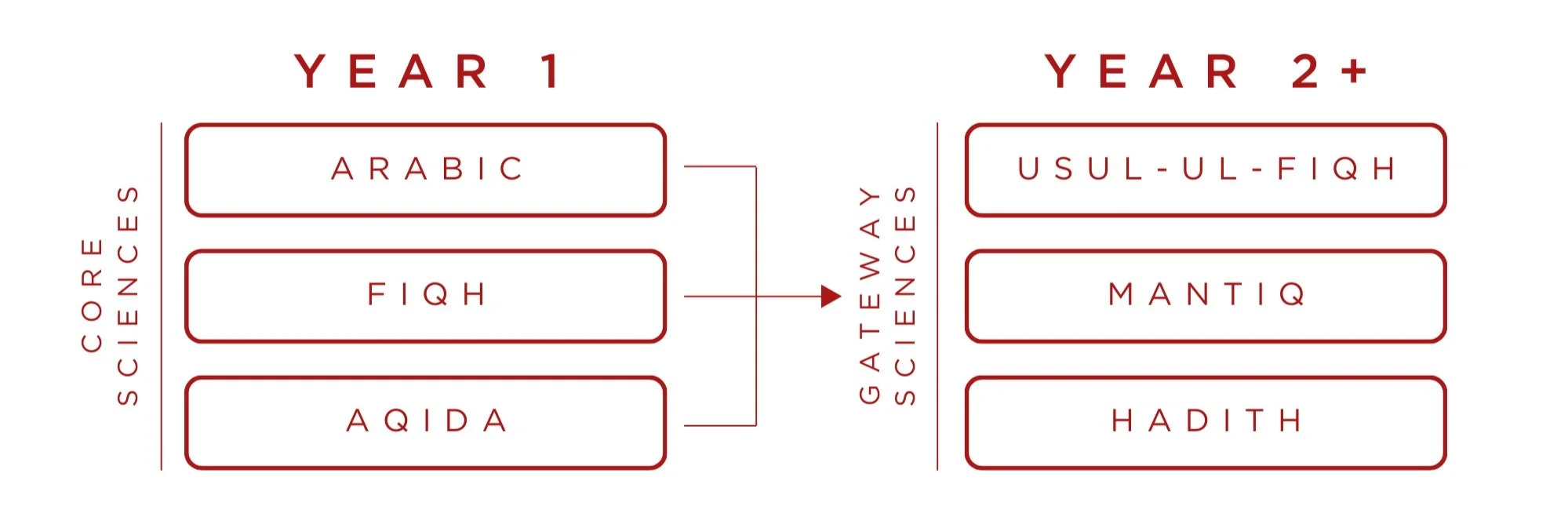
This program is a comprehensive study of the Islamic sciences. The program focuses on cultivating a true Talib ul-Ilm (seeker of sacred knowledge). Year 1 of the program focuses on Arabic, Fiqh, and Aqida. Future years of the program continue with these core sciences and introduce other sciences such as Usul-ul-Fiqh, Mantiq (Logic), Hadith, and more.
CURRICULUM
In each Islamic discipline: Aqida (Theology), Fiqh (Jurisprudence ), Tasawwuf (Spirituality), Nahw and Sarf (Grammar and Morphology), students will study several classical introductory texts, intermediate texts, and even advanced texts in Arabic alongside English translation that are universally studied by students of Islamic knowledge across the world.
PROGRAM OUTCOME
Within the four years of the program, we focus on the following outcomes:
1.
Comprehensive Fluency
in reading, writing, and understanding Classical Arabic and understanding the Qur’an and Sunnah in its original language.
2.
Strong Proficiency
in Islamic jurisprudence, especially ritual law (ibadat), family and divorce law and civil law (muamalat).
3.
Deep Understanding
of Islamic theology (Kalam) and rational and scriptural proofs for Islamic creed.
4.
Fostering a Desire
in the student for da’wah, community work, and spiritual devotion.
OUR PEDAGOGY
Darul Fath's pedagogical approach is exactly the same as the approaches found historically in traditional institutions of Islamic thought, from East to West: universities like Al-Azhar in Egypt, Zeitouna in Tunisia, the circles of knowledge in Damascus, and the Mahdaras and Madaris of Mauritania and Algeria.
The focus is on creating circles of knowledge at the feet of scholars with an unbroken chain (sanad) to the Islamic tradition, studying the exact same books that have been used to train scholars for over 1400 years. Many of the books taught are over 500 years old, and some, like Al-Aqida Al-Tahawiya or the Risala of Ibn Abi Zayd are over 1000 years old.
Unlike institutions inspired by the Western university system, Darul Fath's focus is not on a graduation date or a certificate of completion. Although students will complete readings of dozens of classical texts in Darul Fath, the focus is not on "finishing" a book or curriculum, because a single teaching text (matn) can be revisited dozens of times through its various commentaries (shuruh) and marginal glosses (hawashi) at vastly different levels.
However, in recognition of the need for a predictable schedule and set of outcomes, Darul Fath structures classes into semesters with a set schedule and planned goals.
CURRICULUM TEXTS
The Islamic written tradition (turath) is the richest intellectual tradition in the history of civilization. There have been hundreds of thousands of texts written on every discipline. One of the core pillars of traditional Islamic pedagogy is a scholar training students how to navigate the turath and learn how to read and interpret these texts.
Darul Fath boasts a faculty of scholars who have taken from nearly every geographical tradition of scholarship- from Mauritania in West Africa, to Algeria, to Egypt, to Turkey, to Damascus, to Yemen, to Pakistan and more. Every semester, the scholars select which texts will be covered for each science... some of these texts, such as the core teaching texts (mutun) will be taught repeatedly, while others may be opportunities that are offered once in a lifetime.
Below, is a partial list of texts that we have studied in the past three years.
AQIDA
Level 1 Texts
Aqida Al-Tahawiyya: The earliest systematic text of Aqida by Imam Al-Tahawi on the agreed upon matters of Islamic creed.
Al-Ma'rifa: By Shaykh Abdul-Karim Al-Rifa'i, a reorganization of the Sanusi Creed, with elaboration on modern matters.
Umm Al-Barahin: Also known as Al-Sughra, this is Imam Al-Sanusi's paradigm-shifting summarization of Aqida and Kalam.
Irshad Al-Murid: A reorganization of Umm Al-Barahin written by Ibn Ghalbun, read with a modern commentary by Sh. Abdurrahman Mihrig, focusing on contemporary theological terms in English.
Level 2 Texts
Al-Bidaya fi Usul il-Din: By Imam Nur Al-Din Al-Sabuni, one of the most important texts of the Maturidi school.
Tahdhib Sharh Al-Sanusiyya: Sh. Saeed Fodeh's refinement of Shaykh Ul-Islam Zakariyya Al-Ansari's commentary of Umm Al-Barahin.
Sharh Al-Sawi ‘Ala Jawharat Al-Tawhid: Imam Ahmed Al-Sawi’s commentary on Jawharat Al-Tawhid.
Advanced Texts
Sharh Al-Kubra: Imam Al-Sanusi’s commentary on his seminal text, Al-Kubra. Students in this text also refer back to the text’s various marginal glosses such as Hashiya Al-Hamidi or Hashiya Al-Yusi, with references to other texts such as Al-Aqida Al-Burhaniyya.
HANAFI FIQH
Level 1 Texts
Is'af Al-Muridin: Imam Al-Maydani's primer on Fiqh, with a detailed introductory section on Aqida and Kalam.
Maraqi Al-Sadaat: The famous primer by Imam Al-Shrunbulali focusing on all aspects of Hanafi ritual Fiqh.
Level 2-3 Texts
Nur ul-Idah: A highly detailed text by Imam Al-Shrunbulali on ritual law.
Mukhtasar Al-Quduri: The seminal summarization of Hanafi Fiqh by Imam Al-Quduri.
Special Intensive Texts
Al-Kafaa'a fil Nikah: A specialized text focusing on a single condition of marriage.
Sadh al-Hamama: A text focusing on the pre-requisites of someone to lead the prayer by Imam Abdul Ghani Al-Nablusi.
MUSTALAH AL-HADITH
Taysir Mustalah Al-Hadith: A modern summary of Hadith science by Sh. Mahmud Al-Tahhan, studied in some schools in the Indian subcontinent as an advanced text in Hadith science.
Al Bayquniyya: Imam Bayquni's famous summarization of the various types of Hadith.
USUL UL-FIQH
Al-Waraqat: Imam Al-Haramayn Al-Juwayni's primer on Usul ul-Fiqh, which was read along with Imam Muhammad Al-Hattab's commentary Qurrat Al-'Ayn.
Khulasat ul-Usul: Imam Abdul Qadir Al-Fasi’s compendium in Usul ul-Fiqh summarizing the contents of Mukhtasar Ibn Hajib and Jam’ul Jawami’ by Imam Taj ul-Din Al-Subki.
MALIKI FIQH
Level 1 Texts
Al-Ashmawiyya: Imam Abdul Bari Al-Ashmawi's primer on Maliki Fiqh, focusing on purification, prayer, and fasting.
Kitab Al-Akhdari: Imam Abdul-Rahman Al-Akhdari's primer focusing on Tasawwuf, purification, and prayer.
Al-Murshid Al-Muin: Imam Abdul Wahid Ibn Ashir's 130 line poem focusing on Kalam, Usul Al-Fiqh, the ritual chapters of Fiqh, and a detailed chapter on Tasawwuf.
Level 2-3 Texts
Al-Izziyah: Imam Abu Hasan Al-Shadhili's summarization of Maliki Fiqh, meant to be an introductory text for new students at Al-Azhar during his era.
Qariba ul-Salik: Imam Ali Al-Amrusi's summarization and distillation of Mukhtasar Khalil, the most authoritative text of Maliki Fiqh.
Al-Risala Al-Qayrawaniya*
TASAWWUF
Mahiyyat Al-Tasawwuf: A summary of the characteristics of the people of Tasawwuf and the path, written by Habib Umar bin Hafiz.
Adab Suluk il-Murid: Imam Al-Haddad's guide for the etiquettes of the spiritual wayfairer.
Usul il-Tariq (Zarruq): Sidi Ahmed Zarruq's guide to the principles of the spiritual path and the core pitfalls one encounters.
MANTIQ
Ta'lim Al-Mantiq: An urdu text in Mantiq typically taught to senior students in the Dars e Nizami curricum.
Al-Sullam Al-Munawraq: Imam Abdurrahman Al-Akhdari's 140 line poem on all of the chapters of Mantiq.
Al-Isagoge: Imam Al-Abhari, a contemporary of Imam Fakhr Al-Din Al-Razi's summary of logic, perhaps the most famous text of logic in history.
Al-Maqulat Al-Ashara: A summary of the Ten Categories and their usefulness/pitfalls in Kalam and philosophies.
NAHW
Al-Durus Al-Nahwiyya I & II: The first two books of a modern text in Arabic grammar taught in the famous Ma'had Fath Al-Islami in Damascus and across Islamic colleges in Syria and Turkey.
Al-Ajrumiyya & Sharh Al-Kafrawi: A class taught entirely in Arabic focusing on Al-Hamidi’s marginal gloss on Sharh Al-Kafrawi’s introduction.
MASTERING THE SCIENCES
Traditional study of the Divine Law is focused on developing mastery of the core Islamic sciences, which are Aqida, Fiqh, and Tasawwuf. As the student advances in their studies, they require knowledge of additional sciences to aid their understanding of these sciences, such as knowledge of Nahw (grammar), Sarf (morphology), Mantiq (logic), Usul ul-Fiqh (principles of jurisprudence), Mustalah Al-Hadith (Hadith sciences), and more. The final goal is to be able to understand the Qu'ran and Sunnah in the way that the noble companions and their successors understood it. We structure our curriculum based on that system, as shown in the diagram here.
-
Year 1: Core Sciences
Students will learn core Islamic sciences—Aqida, Fiqh, Tasawwuf—and basic Arabic to build a solid foundation for the following years. By year’s end, students will be able to confidently explain fundamental beliefs, perform essential acts of worship, and thoughtgully engage with classical texts.
-
Year 2+: Gateway Sciences
Building on Year 1, students will continue to explore advanced Fiqh, Aqida, and related sciences. They will also begin learning the gateway sciences. Through practical applications, analytical discussions, and direct engagement with Arabic texts, students will develop fluency and will be prepared to teach foundational concepts to others.